Dreamgirls Review

Reviewed by AI Surf Dude

A model-creation community that feels more like a large visual-character workshop than a basic chatbot, with deep appearance controls, a huge browseable catalogue and enough saved creation infrastructure to reward regular visual experimentation.
Verdict: Dreamgirls behaves more like a large visual-character workshop than a chatbot. Deep appearance controls, a huge browseable catalogue of community models and enough saved-creation infrastructure to keep experimenting make it a place for people who enjoy building and refining a persistent fictional model rather than merely chatting to a preset.
A 3-day trial leads into Pro from $24.95 a month, which is toward the pricier end of the category, so it rewards someone who will genuinely use the creation depth rather than dabble. The visual controls are the real draw, and the community catalogue gives you plenty to riff on, but a user who just wants a quick conversation will be paying for a workshop they never really open.
At 7.7 it has a clear identity: the visual experimentation is the hobby, not a side feature. For a creator who likes tuning a model's look and returning to develop it across sessions, Dreamgirls gives them real room to play, and the score reflects a capable, specialised studio whose main asterisk is a price that only makes sense if you actually put the tools to work.
What Dreamgirls actually is
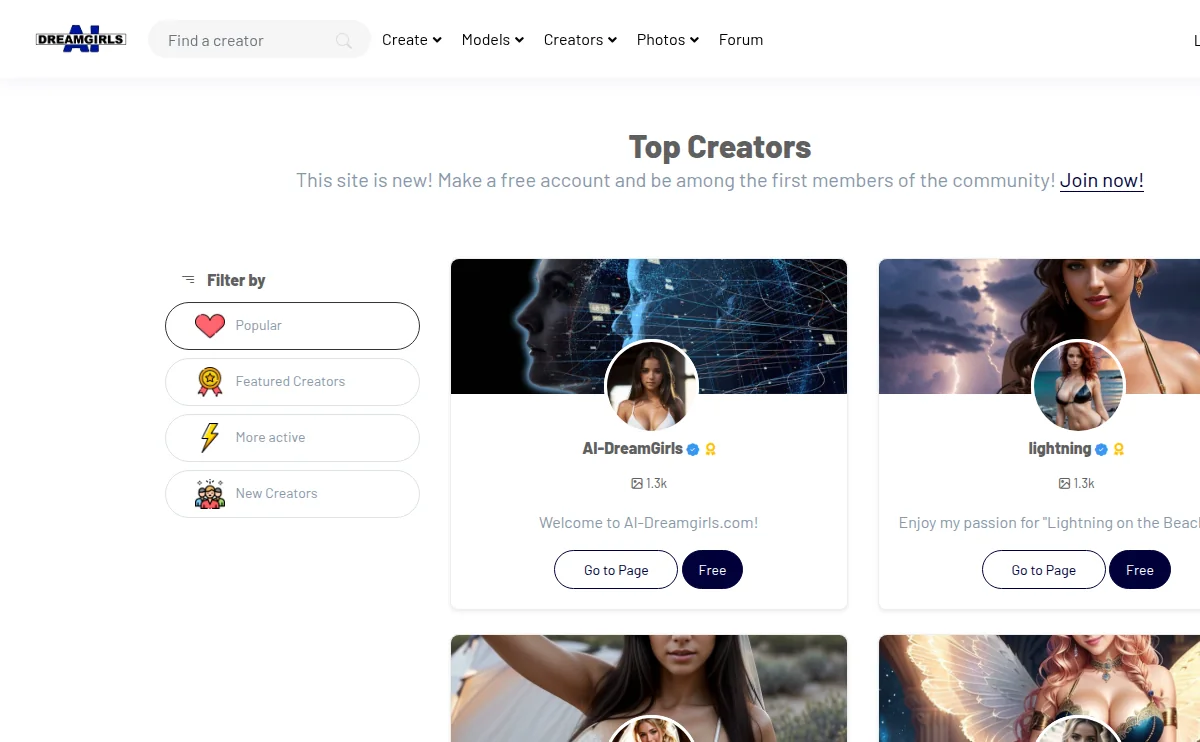
AI-DreamgirlsPro is a creator and community platform for AI models. The public billing material describes making a personal model or working from a catalogue of more than 450,000 premade AI models, then changing attributes such as age, weight, clothing, settings, poses, expressions and hair. It is companion-adjacent because the product centres on persistent fictional models and personal visual profiles rather than a one-off image tool.
Its clearest identity is AI model creator and community platform. That focus makes it easier to decide whether the product fits before another login starts breeding in the password manager.
First impressions and navigation
Dreamgirls gets to its main activity without making a visitor complete a bureaucratic obstacle course first. The useful question—what can I do here?—has a readable answer, and the product feels more like a working service than a brochure with a password field.
The main workflow
Choose a premade model or start a personal one, adjust the visual traits that matter, generate new photos and use browsing, favourites and bookmarks to keep track of interesting work. A defined model gives the workflow a practical advantage: later images can develop an established identity instead of beginning from a blank prompt each time.
The difference between a flashy first click and a product worth returning to is continuity. Dreamgirls provides a workable route to start small, correct course and save the parts that work.
Quality, consistency and reasons to return
The core appeal is scale with a character anchor. A large community catalogue makes discovery easy, while a personal model gives a user more control and a reason to return. The interface feels most rewarding when a creator uses a few consistent appearance choices and develops them across a small body of work.
Customisation and creative control
Model traits, clothing, settings, poses, expressions, hair, image size and privacy settings give users control over the visual identity. That is a stronger fit for someone who wants to work from a model than for a prompt purist who wants every image to start from zero.
Free access and onboarding
The billing page offers a $4.95 three-day trial that rebills monthly unless cancelled. The trial is enough to explore the model-first workflow and determine whether the community and visual controls are worth a longer plan.
Onboarding should answer one honest question quickly: does this product suit the way I actually want to use it? Test the central loop before deciding whether advanced features are likely to matter.
Pricing and value
AI-DreamgirlsPro lists $24.95 monthly, $54.95 for three months and $99.95 for six months; it states subscriptions renew automatically through CCBill. The Pro feature list includes up to 100 new AI photos a day, larger output, saved creations, privacy controls and priority generation.
Mobile experience
Dreamgirls is available through responsive web. The core discovery and session route works naturally on a phone, while detailed character building, visual comparison or account planning benefits from a larger keyboard. That is a normal trade-off, not a design crime.
Privacy and account handling
Use the platform privacy settings for personal models and keep source material or profile details limited to what the visual project requires. Treat generated collections, favourites and saved models as persistent account content.
Content rules
The official login route is adults-only. Keep all work adult, fictional or authorised and do not use a model creator to imitate a real person without consent.
Clear boundaries do not spoil an adult-friendly creative experience. They keep it in the lane where consent and common sense make the tool more enjoyable for everyone.
Billing, cancellation and support
Billing and cancellation are handled through CCBill Consumer Support, with the product account route handling the creator experience.
Strengths and minor limitations
What works
- A model-creation community that feels more like a large visual-character workshop than a basic chatbot, with deep appearance controls, a huge browseable catalogue and enough saved creation infrastructure to reward regular visual experimentation.
- A direct route into the primary experience.
- Useful repeat-visit potential when a user develops a clear direction.
- Adult-friendly fictional framing with practical account considerations.
What to know first
- Live plans and promotions belong at checkout.
- The best results reward a little deliberate setup.
- Detailed configuration is more relaxed on a larger screen.
How Dreamgirls compares
xMode is much stronger for reference-based identity locking and production control; Dreamgirls is stronger for browsing a large community model catalogue and customising a character’s visual traits within that ecosystem.
Who it suits
Dreamgirls is best for creators who enjoy browsing a huge AI-model community, then developing a persistent fictional model with detailed visual controls.
Making the first sessions count
The best way to begin with Dreamgirls is to choose one clear intention and stay with it long enough to understand the product’s rhythm. In an AI model creator and community platform workflow, that may mean a single character, visual identity or scene. A strong starting point gives later choices somewhere useful to go; a dozen unrelated experiments mostly give the history page cardio.
The details that create return value
AI Porn Surf pays attention to the unglamorous details because they decide whether a product survives the first click: saved work that is easy to find, controls that change a result, a straightforward account area and an upgrade that deepens a familiar workflow instead of repairing an artificially broken free one. Dreamgirls is most convincing when those ordinary pieces support the central experience.
Advanced features without the fuss
A practical first-week approach
Dreamgirls does not need to be perfect at every possible task to be a favorable recommendation. It needs to be enjoyable, capable and easy to return to for the audience it serves. That is the quality behind its place in the AI Porn Surf directory.
A deeper look at everyday use
Dreamgirls becomes more useful when the main model-creation workflow workflow is treated as a small ongoing project rather than a one-click novelty. Start with a character, visual direction or setting that has a clear reason to exist, then keep the important details stable while the product does the work it is built for. That gives a user a real baseline for judging progress. A strong first result is not the finish line; it is the point where the next useful choice becomes obvious.
How to get better results over time
Consistency is the secret ingredient. In character work, that means a small number of strong traits and a setting the conversation can return to. In creative work, it means preserving the successful subject, mood or composition while changing one variable at a time. Dreamgirls rewards that habit because it lets the user see which decisions have actually improved the result, rather than encouraging a gallery full of unrelated lucky accidents.
Value without the guesswork
Practical expectations for regular users
A good return visit should feel familiar without becoming repetitive. The character, visual identity or core creative direction needs enough continuity to be recognisable, while the user still needs room to take it somewhere new. Dreamgirls does its best work in that space: a stable foundation, a clear next action and just enough variation to keep the experience from turning into a loop of identical greetings or nearly identical images.
A model-first workflow with a reason to return
Dreamgirls is most compelling when a model becomes a continuing visual project. Browse until a starting point has real potential, use the controls to give that model a distinct identity and return to it with a new setting or expression in mind. That model-first rhythm gives the large community catalogue a purpose beyond endless scrolling and makes saved work genuinely useful.
The community catalogue is most useful when it serves a clear creative decision. Browse with an idea in mind—an appearance direction, a style or a model that could support several later images—then use favourites and bookmarks to avoid losing promising discoveries. That gives the large selection a practical role. It becomes a source of starting points rather than an endless scroll of almost-right options.
A personal model has a different kind of value. Once a creator has chosen the traits that define the character, later work can focus on clothing, settings, poses and expressions without rebuilding the person from the beginning. This is why model-first creation can be satisfying for regular users: the visual identity carries forward, and a saved collection gradually becomes a record of a deliberate creative direction.
The product is best approached with that distinction in mind. Use the trial to decide whether you enjoy browsing, building or a combination of both. If the model workflow has genuine staying power, the paid plan’s larger daily generation allowance and storage make more sense. If it does not, a short exploratory visit has still answered the important question without turning a subscription into another forgotten account.
This is also why a model-first platform can feel more personal than a blank-prompt generator. The saved identity gives each new session a starting point, while the catalogue keeps discovery available when a creator genuinely wants a new direction. Dreamgirls works best when those two modes support rather than replace one another.
In practical use, this is the last useful check before spending more time or money: does the current dreamgirls workflow make the next session clearer than the previous one? If it does, keep building on the direction that works. If it does not, simplify the premise, return to the strongest saved result and let the core experience prove its value before adding another layer. That small discipline keeps the product useful, the project coherent and the next visit worth opening. It also gives the user a clear reason to save the useful work, close the session at a sensible point and return with a genuine next idea.
How this review was built
Method: I used the Dreamgirls browsing and creation path available during testing, then checked its published billing, cancellation and login material dated July 12, 2026. The review does not extend that access into claims about untested paid capacity.
Primary sources: AI-Dreamgirls billing and cancellation, AI-Dreamgirls login/product page. Accessed July 12, 2026.
Final recommendation
Dreamgirls is for builders who enjoy shaping and revisiting a visual character more than chatting with the first preset they see. Explore the community catalogue, make one deliberate model and see whether the refinement loop holds your attention. If you mainly want quick text companionship, this workshop is more machinery than you need.